The sail remains responsive when engaged and disappears instantly when released.
What began as targeted carbon reinforcement evolved into a complete structural philosophy centered around reflex response, load retention, and precision under pressure. Ultra-high-grade carbon laminates minimize elongation and maximize reflex response. Carbon stabilizes the sail profile while preserving immediate energy transfer and crisp release under load.
Body Panels. 1.5 mil Ultra low stretch linear Warp Carbon fiber laminate yarns arrayed to control load lines in the sail combined with super strong Technora Aramid X-Ply. Refined material orientation improves reflex response and energy transfer while maintaining composure through gusts, transitions, and extended use. Durability is built into the structure through carbon X-Ply body panels, reinforced foot materials, protected seams, and carefully controlled load paths. The goal is long-term confidence in handling, structure, and consistent performance. X-Ply Carbon also effectively prevents tears from traveling.
Foot Panels. Warp Carbon foot, tack and center luff panels. 2.0 mil Warp Carbon film combined with super strong Technora Aramid X-Ply yarns increase puncture resistance, minimize stretch, and help maintain sail shape in this critical high-load area. An additional carbon strip below the foot batten further stabilizes the foot panel under load. Nylon pulley rolls reduce weight and friction. The result is lighter handling, cleaner acceleration, increased stability, and a highly connected feel between rider, sail, and wave.
Window Panels. 6 mil Bi-Ply from Dimension-Polyant uses dual PET film layers for improved flex, softer feel, and reduced creasing. Integrated UV inhibitors significantly increase longevity compared to traditional monofilm.
Black Window Frame. The black window frame minimizes reflections and distractions for the clearest possible vision through the sail. Form follows function, and it has become a defining and unifying visual element across the range.
Poly Clew System.
The Poly Clew System with Aramid attachment allows riders to fine-tune power, control, and maneuverability without changing sail size. The aramid attachment point provides exceptional durability with minimal weight.
Details.
The details are not the details. They make the design.
Tack Fairing.
Molded and stitched, this ultra durable tack fairing offers protection for your board and feet, aerodynamics around your extension and a place to store your downhaul rope. Made from abrasion resistant textile, it even protects itself.
Folded Sleeve Edge.
Along the rear edges of the mast sleeve, preventing fraying and premature wear and tear.
Sleeve Opener.
At the top of the boom cut out. Makes sliding the mast into the sleeve that much more quick and easy.
Anti-Chafe Batten Ends.
Protecting the batten pocket leech ends of your sail when rigging on rough surfaces.
Tack Stitch Protection.
Safeguarding the tack area of your sail against stitch breaking from rough board textures.
Hanging Loop.
Lets you hang your sail to dry, or tie a rope, or stick a screwdriver to pull the mast when derigging.
Soft Foot Piping.
Protecting your shins during tweaked maneuvers on wave sails, and your sail against the board deck on flatwater sails.
6:1 Stainless Pulley.
Using all three rolls for an optimized power ratio.
USA Made Films.
All films on all Goya Windsurfing sails are made by Dimension-Polyant in the USA to our rigerous quality standards.
Banzai 12.
World Cup Performance.
Precision, speed, instant response, and rider-driven performance.
Banzai Surf 2.
Ultimate Control.
Softer pull, drift, neutrality, and deeper wave-pocket freedom.
Banzai Max 2.
Maximum Speed
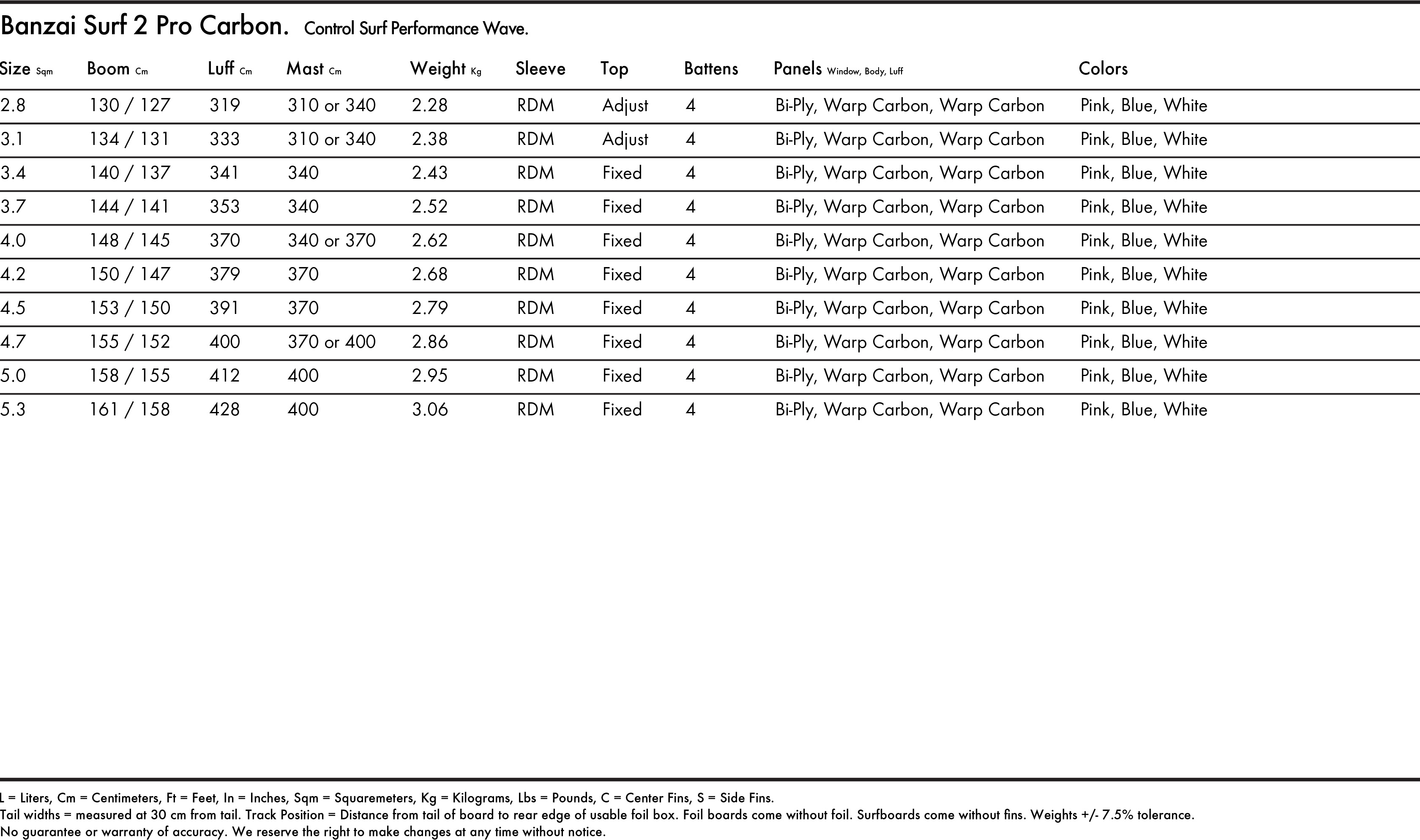
Banzai Surf 2.
Pro Carbon.
Batten Tension.
Before rigging your sail for the first time.
Batten tension is an important tuning detail and should be set before the sail is downhauled. This allows the sail shape to settle correctly and ensures the most accurate representation of the design from the very first session. Taking a few moments to tension the battens yourself establishes the proper foundation for sail shape, stability, rotation, and overall performance. If the sail has already been rigged without first tensioning the battens, completely release the downhaul and outhaul, tension the battens correctly, then re-rig the sail.
How to tension the battens:
• Unroll the sail flat on the ground.
• Insert the Goya Windsurfing batten tensioner (included with every sail) into each batten end.
• Tension the lower battens: Apply enough tension to create a clearly defined shape.
• Tension the upper battens: Apply only enough tension to remove play and hold the batten firmly in place. Do not force additional shape into the sail.
• Avoid overtightening.
A batten may need more tension if:
• Vertical wrinkles appear alongside the batten when the sail is rigged.
A batten may need less tension if:
• It becomes difficult to rotate from side to side.
• It develops an “S” shape.
• It interferes with clean leech release.